
Industrial motion control is entering a new phase. Speed, simplicity, and precision must coexist to keep up with increasing demands.
For decades, motion control has been the backbone of industrial automation. From servo motors driving robotic arms to ball screws enabling precise linear movement, motion systems are responsible for positioning and speed across a wide variety of applications. But as automation continues to evolve, the expectations placed on motion control systems are changing fast.
Today’s machines are expected to deliver higher precision, smoother motion, and greater flexibility, all while being deployed more quickly and maintained more efficiently. That combination is pushing industrial motion control to a crossroads: continue relying on complex, multi-component architectures, or embrace more integrated, plug-and-play approaches that simplify design and accelerate deployment. Across the automation ecosystem, signs point toward the latter.
Industrial Motion Control is at a Crossroads
Rising performance expectations vs. growing integration complexity
Modern automation systems demand high precision and repeatability, particularly in collaborative robotics, inspection systems, and advanced manufacturing processes. Achieving that level of performance often means tighter tolerances, smoother motion profiles, and better synchronization across axes.
Traditionally, meeting those requirements has involved assembling motion systems from discrete components (gearboxes, servo motors or stepper motors, drives, feedback devices, controllers, and cabling), each selected and tuned individually.
Pressure to move faster
OEMs and system integrators are also under increasing pressure to deliver machines faster. Shorter project timelines, workforce constraints, and competitive market dynamics leave less room for prolonged tuning and troubleshooting. Motion control systems that require extensive setup can quickly become bottlenecks in the automation lifecycle.
Parallel trends across automation
This challenge isn’t unique to motion. Vision systems, safety components, and controllers have already shifted toward more modular, integrated designs. Out-of-the-box functionality and standardized communication are now expected in many areas of automation. Motion control is following the same trajectory.
If you are looking to build foundational knowledge, A3’s overview on Understanding Motion Control Basics and Automate’s own Motion Control 101: Fundamentals and Emerging Trends provide helpful context on how the discipline has evolved.
The Shift Toward Integrated Motion Control Architectures
Why traditional motion stacks create friction
Conventional motion systems often involve separate selections for mechanical transmission (such as gearboxes or ball screws), motors, drives, and feedback devices. While powerful, this approach requires careful alignment, tuning, and validation to ensure smooth, accurate motion.
Each interface, whether mechanical or electrical, introduces potential inefficiencies. Cable management becomes more complex. Control cabinets grow. Troubleshooting requires navigating multiple vendors and documentation sets. In addition to this, the process of custom motion control solution development requires a deep understanding of each component in the system, as well as coordination among many suppliers to ensure each component performs as expected.
The rise of plug-and-play motion solutions
Integrated motion control addresses these challenges by combining multiple motion components into pre-engineered assemblies. Motors, gearing, drives, and feedback systems are designed to work together from the start, reducing integration effort and improving predictability. Rather than replacing engineering expertise, this approach allows teams to apply that expertise more strategically, putting focus on system-level performance instead of component-level compatibility. This allows for significantly less time to be spent on validating standard performance of each actuator, which allows products to get to market faster.
Faster commissioning through integration
By reducing the number of components that must be selected, wired, and tuned independently, integrated motion architectures help speed up automation commissioning. In many cases, motion systems can be configured and validated more quickly, helping projects move from design to deployment faster.
What “Plug-And-Play” Means in Industrial Motion Control
.jpg "In industrial automation, plug-and-play motion control helps engineers deploy high-precision motion systems faster by reducing component count, tuning effort, and integration risk.")
Fewer components, fewer failure points
Integrated actuators reduce the number of mechanical interfaces and electrical connections in a system. Fewer parts translate to fewer potential points of failure and less maintenance over time.
Reduced tuning and setup
Because integrated motion components are designed and tested as complete systems, they often require less tuning during commissioning. This can be especially valuable in applications requiring smooth motion, precise positioning and speed control, or frequent redeployment.
Standardized industrial communication
Plug-and-play motion control also relies on standard communication protocols such as CANopen and EtherCAT. These protocols enable motion devices to integrate cleanly into broader automation architectures, supporting interoperability and scalability.
How Harmonic Drive Demonstrates Integrated Motion Control in Practice
One example of this integrated approach was showcased at the Automate Show through a Harmonic Drive demo focused on strain wave gearing and compact actuator solutions.
Zero backlash through strain wave gearing
At the core of Harmonic Drive’s motion technology is strain wave gearing, which inherently supports zero backlash. Unlike traditional gear systems, strain wave gearing eliminates play between gear teeth, enabling high precision and repeatability without extensive compensation. At any given point in time, 30% of the teeth in a Harmonic Drive Component set are engaged, which reduces play at the output to virtually zero, which is why it's called zero backlash. For machine builders, maintaining precision from the bottom up is key for reliability and repeatability. Traditional gearboxes have backlash, which results in positioning error that grows for each degree of freedom that is added to a system.
This characteristic is particularly valuable in collaborative robots and other precision applications where smooth, predictable motion is essential.
High repeatability for robotics and precision applications
High repeatability supports a wide range of applications, from robotic assembly to inspection and material handling. By maintaining consistent positioning across cycles, integrated motion systems help ensure product quality and process stability.
All-in-one actuator architecture
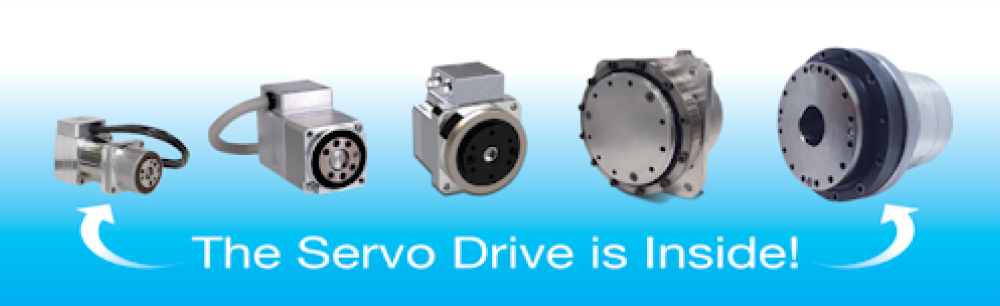
Harmonic Drive’s integrated actuator designs combine a strain wave gear, brushless DC servo motor, and drive into a single compact assembly. This all-in-one architecture simplifies mechanical design and reduces the need for external components.
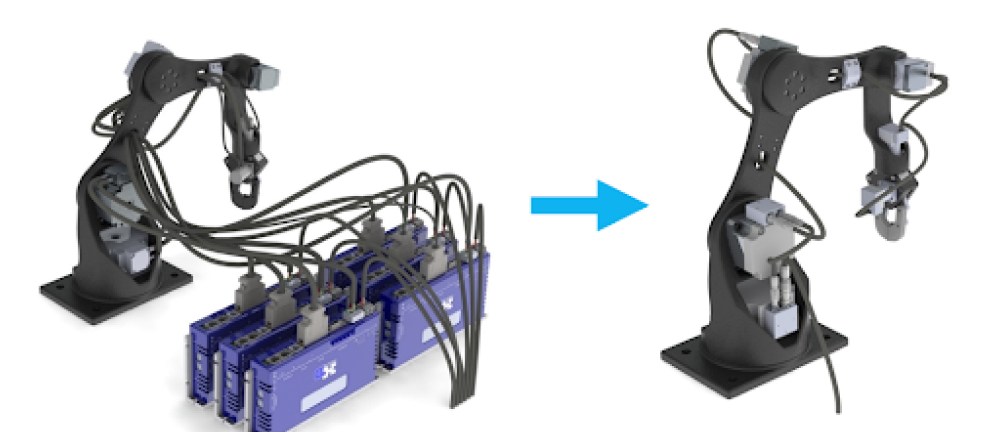
Fewer components also mean fewer cables. In many cases, a single cable supports both power and communication, helping streamline installation and cabinet layout.
Compact designs for modern machines
Space constraints are a growing concern in automation. Compact integrated actuators help designers reduce machine footprint while maintaining performance—an increasingly important consideration in mobile robotics and collaborative systems.
For a closer look at this approach, Harmonic Drive provides an overview of its integrated servo actuator solutions here: Harmonic Drive Integrated Servo Overview.
At Automate, you can see these concepts in action. Watch this Automate Show demo presented by Harmonic Drive’s Marcel Almonte.
Key technical takeaways from the demo
- Integrated gear, motor, and drive assemblies with customization available.
- Single-cable CANopen and DC power for fast configuration
- EtherCAT support for higher-speed industrial communication and plug-and-play compatibility with Industrial EtherCAT networks.
- Dual absolute encoders in SHA and LPA series for precise positioning, with built-in support for external I/O and homing functionality.
Together, these features highlight how integrated motion control can deliver both high precision and ease of use.
What Integrated Motion Control Means for System Integrators and OEMs
For system integrators and machine builders, the implications of plug-and-play motion control are significant.
Faster deployment, lower engineering burden
Integrated motion solutions reduce the amount of engineering time required for component selection, wiring, and tuning. This can help teams meet aggressive project timelines while maintaining performance standards.
Cleaner machine decisions
With fewer components and cables, machines can be designed more cleanly and compactly. This not only improves aesthetics but also simplifies maintenance and troubleshooting.
More predictable motion behavior
Because integrated motion systems are engineered as complete units, they tend to behave more predictably once deployed. This predictability supports consistent performance across machines and installations. In addition to this, end users only need to interface with one manufacturer instead of multiple component manufacturers individually.
Looking Ahead: Industrial Motion Control That Works Out of the Box
As industrial automation continues to advance, integrated motion control is becoming less of a differentiator and more of an expectation.
Modular, scalable automation architectures rely on components that integrate easily and perform reliably from day one. Plug-and-play motion control aligns with that philosophy, enabling faster innovation without sacrificing precision or control.
By reducing unnecessary complexity, integrated motion control allows engineers to focus on building smarter, more flexible automation systems.
On the Automate show floor and beyond, it’s clear that the future of industrial motion control is moving toward solutions that are not only precise and powerful but also easier to integrate, deploy, and scale. Motion that works out of the box isn’t just a convenience. It’s a catalyst for the next generation of automation.
Register for the 2026 Automate Show in Chicago, featuring the world’s leading automation solutions, from motion control to AI, humanoid robots, vision systems, and so much more. Reserve your spot today, and meet with the brightest minds in automation.
« View All Blogs
 Privacy Settings